A Father’s Day Toast
On this Father's Day, I raise a toast to my father who provided me with opportunities and adventures that influenced and inspired me.
My father has always been a story teller, but as he is older now he often will reminisce about the many events in his past. In his words, he has lived an interesting life.
A major component of this interesting life is his career in the National Park Service. On this Father's Day, to honor of my father, I wanted share some of his memories and well as some of my intertwined childhood memories that have shaped my life.
My father studied Horticulture at Texas A&M and that choice helped set his career in motion. Horticulture was not his first choice as he was going to study history, but after his best friend suggested Horticulture, that helped set a path for his future opportunities. He often shares stories from his college years, tales of friends, professors, and campus traditions. After graduation, that same best friend convinced him to head to Washington, D.C., in search of opportunity.
His first job in Washington DC was the humble job of mowing grass for the National Park Service. That simple job did not last long and soon he was very involved with “Lady Bird” Johnson's beautification projects in the nation's capital including leading the training of staff to help fulfill the vision. That marked the beginning of his career with the National Park Service, an organization that he had little knowledge of when he was younger.
The historical parks he was Superintendent at, likely aligned with his interest in history. I often reference my father's National Park Service career, with a simple association of living in Concord Massachusetts, where the American Revolution began and ending in Yorktown Va where the revolution ended. That description is a bit simplified, but I find that it resonates this year with our country’s 250th anniversary.
Minute Man National Park, in Concord Massachusetts, offered a world of adventure for a small child and my Dad enabled it. Many memories include sledding, biking, gardening, craft projects, fishing, and berry picking. He also instilled in us a strong appreciation and respect for nature and that often included exploring the nearby wildlife refuge, which became an expansive ice skating rink in the winter. Other fond memories of Concord include learning to swim at Walden Pond and walking the path around the pond with the lore of Henry David Thoreau. Concord is filled with history and we actually lived in a historical house that we thought had a ghost. Despite, the already haunted inhabitants, one Halloween, my father converted our basement into a haunted tour for the local children and I became a prop as a vampire who sprung to life as children passed. We lived within walking distance to the Old North Bridge and we would cross the bridge frequently to visit his office which was just across the river after passing another historical house in which Nathaniel Hawthorn used to live in.
As a child growing up in Concord, I don't remember July 4th as a holiday, as much as I remember April 19th, which is a New England holiday marking the battle of Lexington and Concord. We happen to live in a historical house called the Bullet Hole house. It was called the Bullet Hole house because during the battle of Concord, the owner of the house was shot at by British troops, leaving a bullet hole in the side of the house. Our neighbors at the time were direct decedents to Paul Revere and often were part of a North Church commemoration of the events. We lived with history and historical reenactments. I remember the yearly reenactment of the Paul Revere's ride with reenact-ors dressed for the part racing on horseback through a nearby orchard. Our lawn was often a front row seat to a parade of fife and drum .
During our time at Concord, there was an antiwar protest march organized by John Kerry and other Vietnam veterans. My father brought me to the march when I was 5 years old. My Dad carried me on his shoulders as I proudly held my hand in the air with a peace sign. One of my Dad's favorite folk songs is the Arlo Guthrie classic, called Alice's Restaurant. This protest song likely aligns with another theme in my father's Park Service career and that is of political protest.
The park itself became the site of a major protest on April of 1975. One of the main themes of these protesters was the pardoning of President Nixon. It was timed with a visit from President Ford. The event created a controversy in the community and my Dad defended his decision to grant the permit for the protesters in a Boston Globe article saying "We are not selective when we uphold the Constitution".
Another dramatic event occurred in the park a couple of years earler and that is when an undetontated bomb was found at the base of the Minute Man Statue. The event prompted my Dad to organize an effort to ensure there would be a way to accurately repair the statue if it was ever damaged. This foreshadowed another bombing event that occurred when he was the Superintendent of the Statue of Liberty.
We moved to the Statue of Liberty in 1977, just after the Bicentennial celebrations of 1976. This new park's history exposed us to another facet of American history which focused on American Immigration. As children we climbed the stairs of the Statue of Liberty frequently. Protesters would also climb the stairs so that they could handcuff themselves to the handrail in the crown. This would provide guaranteed exposure on the nightly news. We once met Muhammad Ali when he joined a protest led by Indigenous peoples of the United States at the Statue. The island was also a popular stage for many other events including movies, commercials, and the great David Copperfield magic trick of making the statue disappear.
The biggest event while we lived there was the restoration of the Statue of Liberty and Ellis Island along with the associated Centennial celebration. When my Dad first began his tenure at the Statue of Liberty he recognized planning for the centennial needed to occur as soon as possible, because he knew first hand from his experience in Concord, these events needed careful planning. He helped start and organize, the Statue restoration project which finished in time for the Centennial celebration.
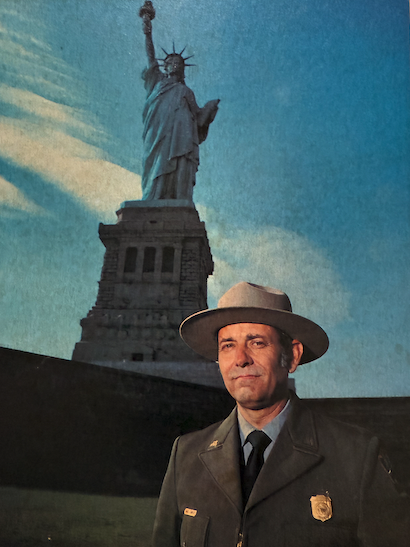
While we lived at the Statue, a bomb was detonated after hours in the immigration museum, which is located at the base of the statue. While watching TV that evening, we heard the bomb detonate. After that, the island got another permanent resident and that was a bomb sniffing dog. At other times, we also shared company with German Shepard attach dogs when extra security was needed for the centennial events.
It was a very unique experience to have lived on the island and there was always a fascination about it from journalist and media outlets. The first year we lived there, our family was featured in a New York Times’ article. Once our Thanksgiving dinner was broadcasted on the Today show. Our unique living situation was part of other publications and it even found us on Japanese television . To support the public exposure, my Dad was given training in dealing with the press as he toured the country to help support the restoration efforts.
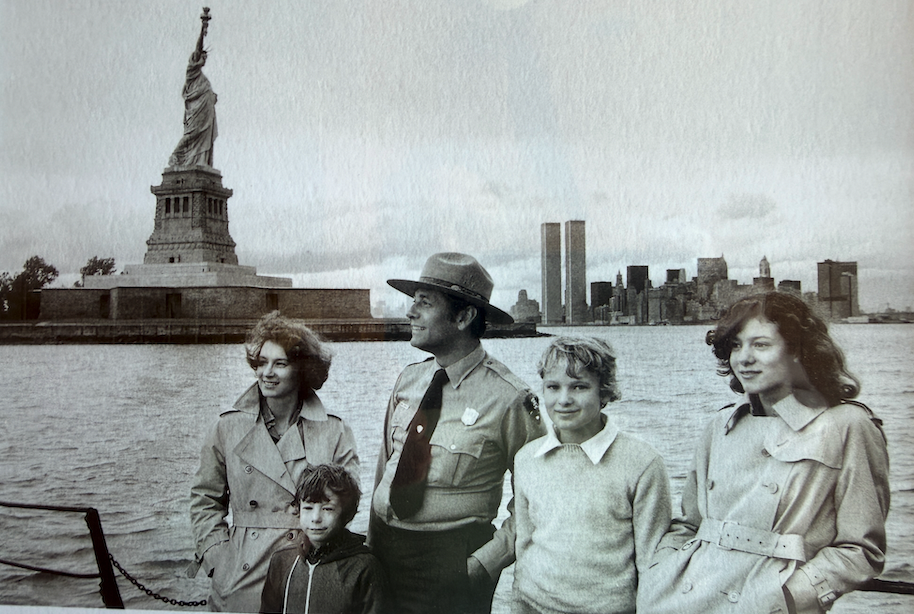
Living so close to NYC also provided many other unique opportunities. Growing up around the architecture of New York first inspired me to consider a career as an architect. Ultimately, I studied art, as did my brother and sister. My mother and father were likely apprehensive that all their children were considering careers that did not come with financial stability, but despite that they allowed us the freedom to choose our paths. Ultimately our choices were influenced by our parent's own creative outlook and interests.
We moved to Yorktown Virginia after living at the Statue of Liberty for 10 years. It was a huge change in lifestyle in many ways, but the gift of being able to go to the grocery store without taking a boat was memorable. Despite that, many things were similar to what we had experienced before. We lived in a historical house once again and there were fife and drum parades in front of our house. October 19th became the new special holiday, which is the day the British surrendered at Yorktown. My father did not actually end his career in Yorktown and instead returned to Washington to work directly at the Department of the Interior where he had an opportunity to more directly affect policy. In that position, he had opportunities to testify before Congress. He had many other adventures while there, including crossing paths with Bill Clinton on the National Mall during a morning walk.
My father's interesting life provides me with inspiration and exposed me to opportunity. The unique experiences not only contributed to interesting stories, but certainly contributed to who I am today.
Cheers to my Father
With Much Love
John